
DYNASTY STARTUP DRAFT STRATEGY GUIDE 2026
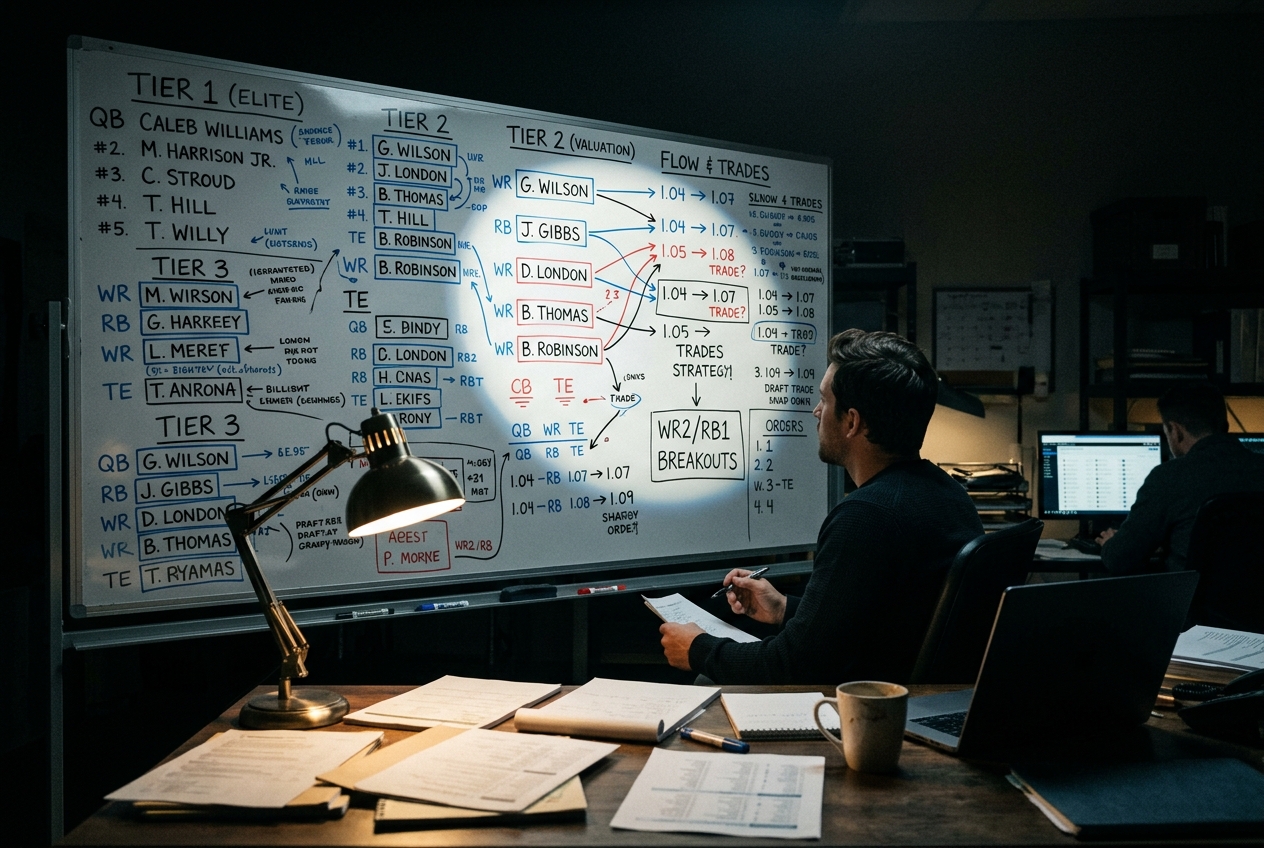
A startup draft only happens once per league. Every other draft you'll ever do in this league — rookie drafts, waiver pickups, trades — is downstream of the roster you build today. Get it right and you're competing for the next five years. Get it wrong and you're rebuilding before Week 1. Here's the complete strategy, position by position, round by round.
HOW A STARTUP DRAFT IS DIFFERENT FROM EVERYTHING ELSE YOU'VE DRAFTED
If you've only played redraft, the format shift catches people off guard. A redraft league resets every year and runs 15 rounds; a dynasty startup draft pulls from the entire NFL player pool — every rookie, every veteran, every bench player — and typically runs 25 to 30 rounds, because you're not just filling a starting lineup, you're stocking a bench you'll live with for years. There's no waiver wire bailout for a bad pick in round 3. The player you take is yours until you trade him or cut him.
That changes what "good value" means. A 28-year-old having a career year is a great redraft pick and a mediocre dynasty pick, because you're paying for one season of production while giving up two or three years of decline. The core discipline of a startup draft is separating "who's good right now" from "who's going to still be good when it matters."
CORE PHILOSOPHY: DRAFT FOR VALUE AND LONGEVITY
Every dynasty strategy article says some version of "draft youth," and it's repeated so often it stops meaning anything — so here's the actual mechanism. Player value in dynasty is a function of two things: current production and remaining years of production. A 23-year-old putting up WR2 numbers and a 29-year-old putting up the exact same numbers are not the same asset, because one of them has five more years of prime ahead of him and the other has one or two.
This is also why rookies and second-year players routinely go earlier in dynasty startups than their current NFL production would justify in a redraft — the market is pricing in the years, not just the stat line. Check the live chart to see how age and production interact in real dynasty values right now.
POSITION-BY-POSITION STRATEGY
QUARTERBACK: EVERYTHING DEPENDS ON YOUR FORMAT
This is the single biggest strategic fork in a startup draft, and it's format-dependent, not preference-dependent.
In Superflex leagues, quarterback is the scarcest premium asset in the game. With 24 teams able to start a QB league-wide instead of 12, the depth of "startable" quarterbacks doesn't come close to meeting demand. If you're in a Superflex league, you should be leaving your startup draft with two, ideally three, startable quarterbacks. Waiting on QB in Superflex is the single most common startup draft mistake.
In 1QB leagues, the opposite is true. QB is streamable off the waiver wire in a way no other position is, so paying an early-round price for a quarterback is usually value you could've spent on RB or WR instead.
RUNNING BACK: THE AGING CURVE IS REAL AND STEEP
Running back value falls off a cliff earlier than any other position — the wall tends to hit around age 27-28, sometimes sooner depending on workload. This is the single fact that should drive your entire RB approach.
Hero RB — take one true bell-cow back early, then pivot hard to WR depth for the next several rounds before circling back for RB depth late.
Zero RB — skip running back almost entirely in the early rounds, loading up on WR and elite TE, then mining RB value in the middle-to-late rounds where injury and opportunity create bigger swings than talent does.
WIDE RECEIVER: THE SAFEST PLACE TO BE PATIENT
WR careers run longer than RB careers and the position is deeper league-wide, which means the dropoff from your WR1 to a usable WR3 is much gentler than the equivalent dropoff at running back. That makes WR the position where being patient costs you the least — you can find genuine WR2/WR3 value in the middle rounds that simply doesn't exist at RB by that point in the draft.
TIGHT END: ONE DIFFERENCE-MAKER, OR NONE AT ALL
The gap between the handful of true TE1s and the replacement-level rest of the position is enormous. Either you land one of the handful of true difference-makers, or you punt the position entirely and stream it later — the middle tier of TE isn't worth an early pick in either case.
TIER-BASED DRAFTING
Ranking players 1 through 300 and drafting strictly in order is a beginner mistake. Tier-based drafting groups players into value clusters. Once you think in tiers, two things become obvious: if you're choosing between two players in the same tier, take whichever one you believe in more — the value gap inside a tier is negligible. And if you're choosing between tiers, take the higher tier almost every time.
Check the tiered rookie rankings to see this principle in action with the current class.
ROUND-BY-ROUND DRAFT PLAN
Rounds 1-3
Elite, young WR/RB (and QB in Superflex)
Take the best long-term asset on the board. Age and opportunity matter more than last year's box score.
Rounds 4-7
Fill your starting lineup; lock in QB1 if 1QB
This is where 1QB drafters take their starting quarterback. Superflex drafters should be closing out their RB1/WR1 tier here.
Rounds 8-12
Your one difference-making TE, more RB/WR depth
If an elite TE fell to you, take him here. Otherwise keep stacking RB/WR depth — rosters are won in these rounds.
Rounds 13-18
Rookies and second-year breakout candidates
A 22-year-old with a real path to touches is worth more here than a 30-year-old veteran.
Rounds 19-25+
Youth, upside, and depth at every position
Swing on unproven players with real opportunity. These are bench pieces either way.
COMMON STARTUP DRAFT MISTAKES
Drafting your favorite team's players
Fandom and dynasty value are not the same thing, and it's the single easiest way to overpay.
Overpaying for one great contract year
A career year doesn't guarantee the next one — check the underlying opportunity rather than just the final stat line.
Ignoring your league's scoring settings
Superflex, TE Premium, and PPR settings each shift positional value significantly.
Punting the back half of the draft
The players you take in rounds 15-25 are next year's trade chips and this year's injury-replacement plan.
FAQ
How many rounds is a dynasty startup draft?
Most dynasty startup drafts run 25 to 30 rounds, since rosters need enough bench depth to carry a full season plus stashes for the following year.
Should I draft a quarterback early in a startup draft?
It depends entirely on your league's format. In Superflex or 2QB leagues, aim for two startable QBs by round 7. In standard 1QB leagues, QB can wait until the middle rounds.
What's the difference between Zero RB and Hero RB strategy?
Zero RB avoids running backs in early rounds in favor of WR/TE. Hero RB takes one true bell-cow RB early, then pivots to WR. Both respond to the same fact: running back value declines faster than any other position.
Should I draft rookies in my dynasty startup?
Yes, typically in the middle rounds (13-18). Most startup drafts favor established production early and let rookie upside fill out the middle and late rounds.
CHECK VALUES BEFORE YOU DRAFT
See where every player stands on the live dynasty value chart, or use the Trade Calculator to evaluate deals during your draft.